
Switching broadband provider has never been easier. As long as you’re outside the fixed term of your original contract, you can compare broadband deals and switch without any exit fees and almost no admin.
If it’s been a while since you last switched, you can probably get a much faster connection. Compare some of the best broadband deals available in your area using our postcode checker.
One Touch Switch aims to simplify the broadband switching process by removing the need for you to contact your current provider.
Instead, broadband providers will be obligated to contact each other to arrange the switch on your behalf, helping to offer a quicker, more efficient service. Providers must comply with industry standards as part of their switching conditions.

Visit our guide on one touch switching to find out more.

There are several different types of broadband currently available:
ADSL is the oldest type of internet connection and is currently being phased out2. ADSL internet packages tend to be the cheapest because of the slow speeds. In theory ADSL broadband can reach speeds of up to 24Mbps, but if this is the only option for your home, expect to see ADSL broadband deals offering around 10Mbps.
Over two-thirds of UK households have access to full fibre broadband.3 This is the fastest type of connection, capable of download speeds of up to 1,800Mbps.4 With full fibre, there is a fibre optic cable directly connected to your home. That’s why it’s also called FTTP, or Fibre to the Premises.
FTTC means you’re connected to the UK’s fibre network, but the final link from your home to the roadside cabinet is an old-style copper telephone line. (It’s also called “hybrid fibre” for this reason.) Almost every home in the UK can access this type of connection. Infrastructure provider BT Openreach says that FTTC can give you download speeds of up to 76Mbps.5
This uses the same wiring as cable TV to deliver your home internet connection. In theory, cable broadband has slower maximum speeds than full fibre. But Ofcom reported in 2023 that cable broadband connections were delivering faster speeds on average in the UK.6
The main provider of cable broadband in the UK is Virgin Media.
This works in the same way as mobile broadband, but rather than a tiny battery-powered router you get a bigger one that plugs into the wall. 4G or 5G home broadband tends to achieve higher speeds than mobile broadband. It’s more reliable too.
Satellite broadband uses a satellite dish to receive and transmit information. If you don’t have any kind of wired connection, this could be a lifeline. But it’s expensive compared to fibre broadband and your signal will be affected by bad weather. We would only recommend it if you’re in a remote area where the signal is too poor for 4G broadband and you have no other option.
Mobile broadband picks up the same network signals as your mobile phone, then converts them to wifi. The router is small enough to carry in your hand, so you can take your wifi with you. The speed you’ll get is heavily dependent on your location, mainly:

Switching your broadband provider can be one of the easiest ways to bring down your utility costs, with many providers offering discounted rates for new customers and even generous gift vouchers as a part of their deals.
If you're experiencing frequent interruptions or slow speeds, switching to a more reliable network can help ensure you're receiving the service that best suits your needs.
With the new One Touch Switch process in the market, transitioning to a better provider is now easier than ever. Not only can this lead to savings, but you may also experience improved speeds and greater reliability overall.”
There’s plenty to consider when comparing broadband deals, including:
Your optimal broadband speed depends on how many people will be sharing your connection and what they’ll be doing online.
Use our bandwidth calculator to get your recommended broadband speed.
Do you want a broadband-only deal or a bundle that combines it with another service?
A broadband-only deal is the most straightforward option and works if you:
If you need a landline, you’ll have more choice if you get your phone and broadband in one deal.
Landline service in the UK is changing as we upgrade to a digital network, but your new provider should supply everything you need for the change. The biggest headache about the digital switchover is that landlines won’t work in a power cut. If one of your reasons for having a landline is for emergency use, contact your provider about getting a backup power unit.
A combined broadband and TV deal could save you money if you watch (or want to watch) paid-for TV channels like Sky Sports or Nickelodeon. It’s often cheaper than having separate contracts for broadband and TV.
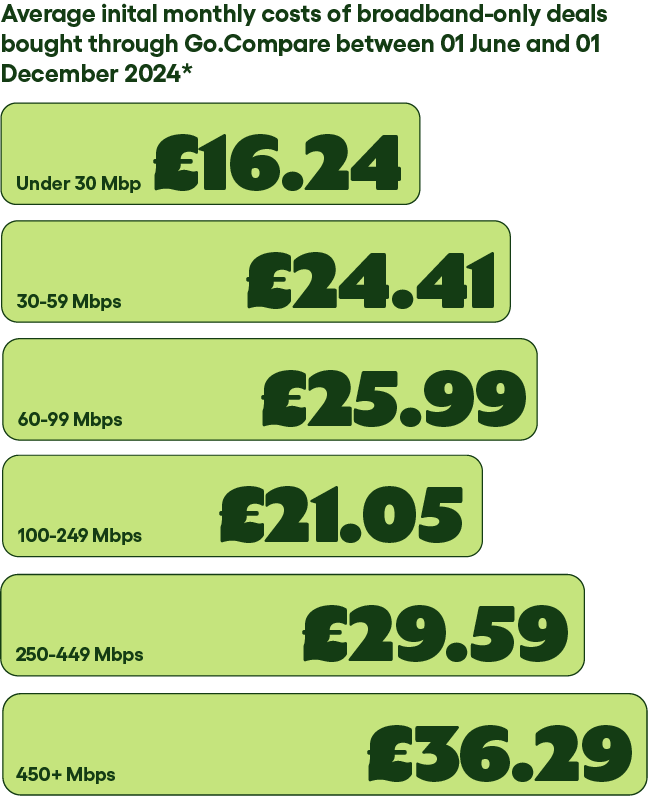
We’ve pulled together the prices paid by Go.Compare broadband customers for different speed categories.7
The low monthly price for 100-249 Mbps broadband in our table may surprise you. This is because the table only compares headline prices - the advertised price that you pay at the start of the contract. During your contract, monthly payments can go up in two ways.
There may be a mid-contract price rise . This is a fixed price increase, usually in line with inflation.
Some providers offer a deep discount at the start, perhaps for the first six months, then hike up prices when the promotional period ends. With this kind of deal, prices could double after six months or so.
All this information will be in the terms and conditions. So before you commit, think about the price you’ll pay over the duration of the contract rather than just the initial monthly cost.
Various things affect the broadband speed you experience:
Other users can also slow things down for you. If other family members are hogging your home’s connection, there’s less bandwidth available for you. Even if you live alone, you could experience lower speeds at peak times if you’re in an area without a fibre network.
Not necessarily. The advertised top speeds have to be achievable, but they don’t have to be available 24/7. Older networks will be slower at peak times.
If your provider has signed up to the Ofcom code of practice on residential broadband speeds, you will get realistic information about likely speeds and a minimum speed guarantee. But this code of practice is voluntary, so not all providers sign up to it. There’s more information on the Ofcom website.
We often use the terms interchangeably, but technically they mean different things.
Broadband is the data transmission that comes through the wires of your internet connection. Wifi is the way your router turns that data into a wireless signal and bounces it to your laptop, tablet or phone. If you’re having internet problems, it’s always worth physically connecting your device to the router so you can rule out wifi issues.
The best time to switch is when you’re outside the minimum term of your contract, so you won’t have to pay any exit fees.
So the best time to start comparing new broadband deals is about 30 days before your contract term ends.
Switching providers is easier than ever before, now that regulator Ofcom has brought in a measure called “ One-Touch Switch”.
As of September 2024, you don’t have to tell your current provider when you want to switch as your new provider will do it for you. Your old and new provider will then coordinate with each other to ensure a seamless switch. There should be no gap in your broadband provision and no overlap period where you’re paying two providers.
Use our postcode checker to find out what broadband deals are available where you live.
No. Full fibre and cable broadband deals don’t need a phone line to work.
Part-fibre and older-style ADSL connections do need a phone line to work, but that doesn’t mean you have to sign up to a landline phone plan. Occasionally a quirk of pricing could mean it’s cheaper to get a landline included, but the days when it was compulsory are over.
With the new One Touch Switch process, you no longer need to contact your current provider to cancel your service.
One Touch Switch simplifies broadband transitions, allowing you to change providers without the hassle of notifying your current provider. They should handle the entire process, ensuring a smooth switch with minimal disruption.
For more details, see our One Touch Switch Guide
No. One Touch Switch means your old and new broadband provider should work together for a switchover with no gaps in service.
Yes, if you’re still within the 14-day cooling-off period. After that it’s more complicated. Our page on broadband cancellation rights explains more.
Some providers will let you transfer the same contract to a new address for free. Others will charge a fee. It’s also possible (but unlikely) that they don’t offer a service in your new location. Our guide to broadband and moving house explains more.
If you’re mid-contract, your broadband provider has an obligation to meet the terms of the contract. Check the terms and conditions to find out what your rights are in the event that they can’t provide your broadband any more.
Price is a big factor when it comes to comparing broadband deals from different providers, but it’s not the only thing you should consider.
Speed, reliability, customer support and more are just as important when it comes to choosing a broadband provider that’s right for you.
No, Go.Compare doesn’t cover every single broadband provider out there. Instead, we work with a selected panel of providers that we trust to deliver a certain level of service for our site users.
Useful broadband guides
Find out more
Find out more
Find out more
Find out more
Find out more
Find out more
[1] As of 6th June 2026, there are 26 active broadband providers on the panel at Go.Compare
[2] BT Openreach, We’re retiring our copper network , last checked 16 December 2024
[3] Ofcom, Connected Nations report, published 5 December 2024, last checked 9 January 2025
[4] BT Openreach, Full Fibre Broadband , last checked 9 January 2025
[5] BT Openreach, Fibre Broadband , last checked 9 January 2025
[6] Ofcom, Latest home broadband performance trends revealed , 14 September 2023, last checked 9 January 2025
[7] Average initial monthly costs of broadband-only deals bought through Go.Compare between 01 June and 01 December 2024.
Page Last Updated Date: 16th January 2025
Visit the Go.Compare editorial guidelines page to learn how we help equip you to make an informed choice.